
Marketing budgets don’t grow on trees, and every brand big or small eventually faces the same dilemma: should the money go into a traditional TV commercial, or into a digital ad film built for online platforms? It’s not a simple either-or decision anymore. Both formats can work brilliantly, but they’re built differently, they’re watched differently, and they deliver different kinds of results.
In this blog, we’ll walk through what a TVC actually is, what makes an ad film different, how the production process changes between the two, and what the video production landscape looks like in Dubai specifically.
What Exactly Is a TVC?
A TV Commercial, commonly shortened to TVC, is a short promotional video made specifically for television broadcast. Typically running between 15 and 30 seconds, a TVC is designed to deliver a clear, memorable message within a very tight time frame. Its biggest strength lies in reach — when a TVC airs during a popular show, a cricket match, or prime-time news, it reaches an enormous, largely captive audience all at once.
For brands planning more cinematic commercial campaigns, film production in Dubai can cover everything from creative development to post-production.
Because of this, TVCs have historically been associated with credibility and prestige. There’s a certain psychological effect at play when people see a brand advertising on television, they tend to assume it’s an established, trustworthy company.
The trade-off, of course, is cost. Producing a TVC is only half the expense the real cost usually comes from media buying, i.e., paying networks for airtime.
What Exactly Is an Ad Film?
An ad film, on the other hand, is a broader and more flexible format. While a TVC is built to fit into a broadcast slot, an ad film doesn’t have those same restrictions. Ad films are usually more cinematic in nature, think stronger visual storytelling, deeper emotional arcs, and a narrative style that feels closer to a short film than a traditional advertisement.
Ad films are made primarily for digital distribution, social media platforms, YouTube, brand websites, and paid digital campaigns. This opens the door to precise targeting: a brand can create multiple versions of the same ad film, each tailored to a different audience segment, region, age group, or even language.
How Production Approach Differs Between the Two
A TVC is built around the idea of a captive audience. Since viewers are already sitting and watching television without the temptation to skip, a TVC can afford a slower build-up.
An ad film has to work under completely different assumptions. Digital viewers are often scrolling through their phones, half-distracted. That means an ad film needs a strong hook within the very first two to three seconds otherwise, the viewer simply moves on. Pacing tends to be faster, and framing is often optimized for vertical or square formats.
Understanding the complete workflow is also useful before starting a commercial project. This film production workflow from pre-production to post-production explains how planning, filming, editing, and delivery fit together.
Cost and ROI: A Real Difference
High-end production value can cost roughly the same whether you’re making a TVC or an ad film. The real difference shows up in distribution costs.
Television media buying is expensive and relatively inflexible. Measuring the ROI of a TVC is also notoriously tricky. Brands often rely on indirect indicators like a rise in overall sales or branded search volume.
Production costs also depend on the complexity of the shoot, crew, locations, equipment, and post-production requirements. Brands can review the broader video production services available in Dubai before deciding on a production approach.
The Production Landscape in Dubai
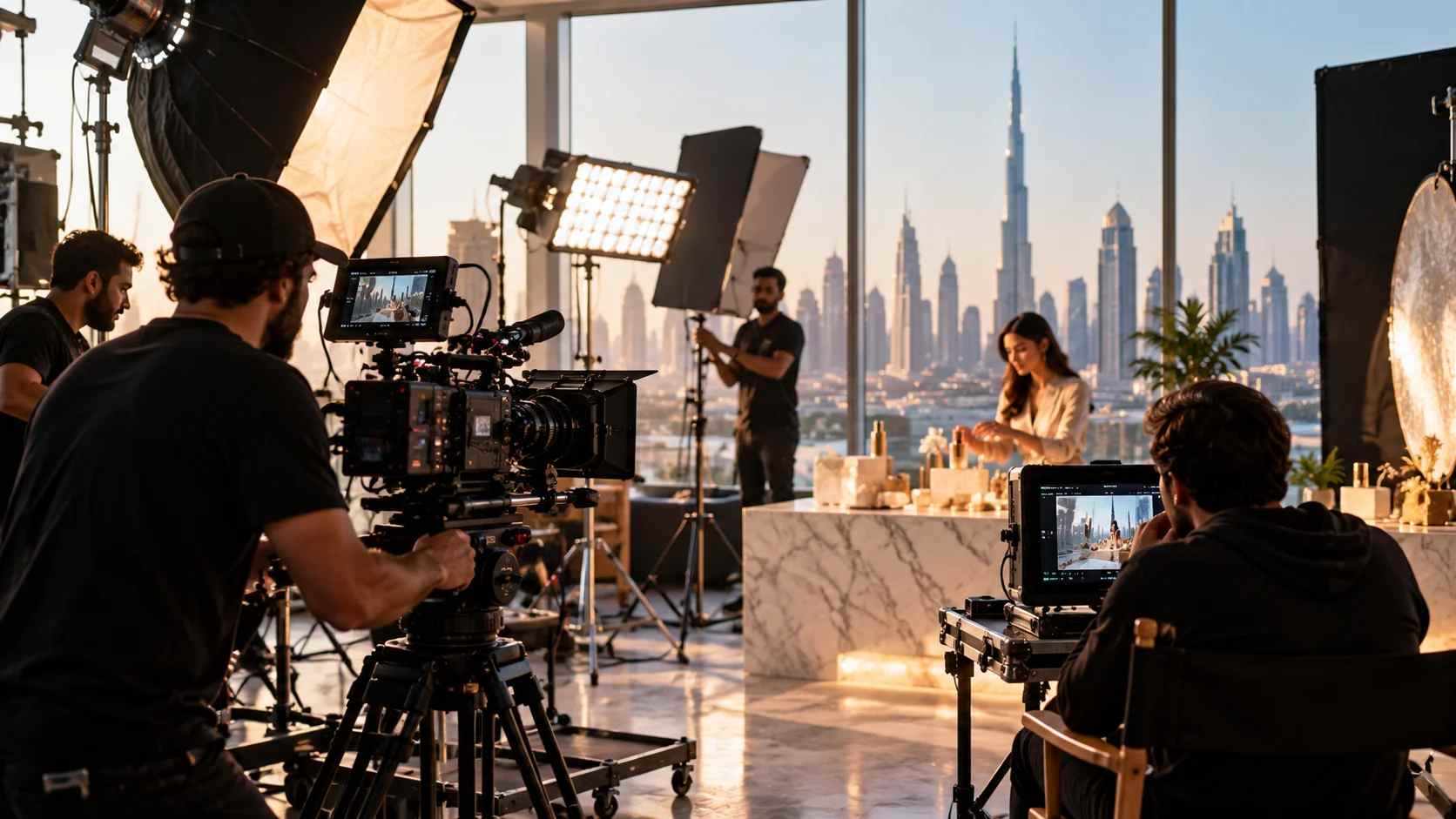
Dubai has firmly established itself as a major regional hub for high-end video and commercial production. With infrastructure like Dubai Studio City supporting large-scale shoots, the city has become a go-to destination for brands across the Middle East.
Doleep Studios is known for its work in TVC production, combining strong storytelling with advanced production technology including drone cinematography and CGI to create high-impact commercials. People Perfect Media is another well-regarded name, specializing in TV commercial production tailored to a brand’s specific needs, often working across both English and Arabic language requirements.
This bilingual approach is a defining feature of Dubai’s production scene, given the city’s mix of local, expatriate, and international audiences.
TVC or Ad Film Which One Should You Choose?
If your goal is to build fast, large-scale brand awareness and you have the budget to support a significant media buy, a TVC can still be a powerful tool.
If your goals are more performance-driven generating leads, driving website traffic, increasing app downloads, or achieving measurable e-commerce sales a digital ad film is usually the smarter investment.
In practice, many brands don’t have to choose just one. A hybrid strategy, a TVC for broad awareness and an ad film for targeted digital engagement often delivers the best of both worlds.
Final Thoughts
The debate isn’t about which format is “better” in an absolute sense, it’s about which format fits your brand’s current goals, audience, and budget. Dubai’s production ecosystem, with studios like Doleep Studios and People Perfect Media leading the way, gives brands access to world-class production quality for either format.
FAQs
1. What is the main difference between a TVC and an ad film?
A TVC is a short video (usually 15-30 seconds) made for television broadcast, while an ad film is longer, more cinematic, and made primarily for digital platforms.
2. Which one is more expensive, TVC or ad film?
Production costs can be similar. The bigger difference is in distribution TV airtime is usually far more expensive than digital ad spend.
3. Can I use the same video for both TV and social media?
Not effectively without re-editing, since TV uses 16:9 format with a slow build-up while social media needs 9:16 or 1:1 with a fast hook.
4. Which format gives better ROI tracking?
Digital ad films offer clearer ROI tracking through closed-loop attribution views, clicks, and conversions are all measurable.
5. Is a TVC still relevant in 2026?
Yes, especially for large-scale brand awareness or older demographics but for lead generation and sales, ad films usually perform better.
6. Why is Dubai considered a good hub for TVC and ad film production?
Strong infrastructure, advanced technology, and bilingual (English/Arabic) production capability for a diverse, multicultural audience.
7. Which Dubai production houses are known for TVC work?
Doleep Studios and People Perfect Media are well known for TVC production in Dubai.
8. How long does it take to produce a TVC or ad film?
Timelines vary based on script complexity and post-production needs; simple videos are faster, CGI-heavy ones take longer.
9. Do I need a bigger budget for a TVC compared to an ad film?
Not for production necessarily, but yes for distribution, since TV airtime costs add up quickly.
10. Should a new or small brand start with a TVC or an ad film?
Most small brands benefit from starting with a digital ad film; it’s more budget-friendly and gives measurable, adjustable results.